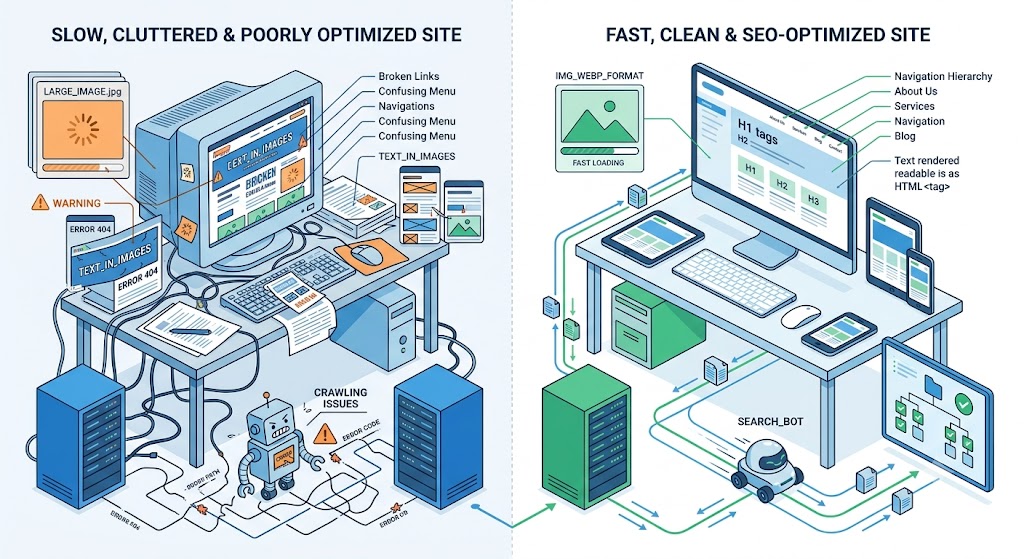
Two forces drive online discovery. One is the content you publish — the words, images, and information your audience seeks. The other is the structure that delivers that content to both human eyes and machine crawlers. Most businesses invest heavily in the first while giving the second almost no thought.
That oversight explains why countless well-written websites fail to appear in search results. The writing is strong. The information is valuable. But the vessel holding it all together works against the very people trying to find it. Understanding this relationship changes how you approach every digital project.
Giving Crawlers a Roadmap
Google sends automated programs across the web to discover and catalog pages. These programs operate by following links — landing on one page, reading it, and clicking through to whatever that page connects to. Your site’s internal linking structure is essentially the road system these crawlers travel.
If those roads loop back on themselves randomly, crawlers waste time revisiting pages they have already cataloged. If important pages sit isolated with no incoming links, crawlers may never reach them at all. If your deepest blog posts sit four levels below the homepage with no supporting links from intermediate pages, their chances of being indexed drop dramatically.
A well-planned site structure solves these problems before they emerge. The homepage branches into broad category sections. Each section contains related pages linked to one another. Every page maintains a clear path back to the homepage and forward to deeper content. This interconnected web ensures no corner of your site remains invisible.
Building this kind of structure requires someone who thinks in systems rather than screens. Before choosing any visual element, a competent professional maps the relationships between every page and ensures those relationships translate into working links.
Phones Are the Primary Screen
Google’s shift to mobile-first indexing redefined which version of your site determines your ranking. The search engine no longer starts with your desktop layout and checks mobile compatibility as an afterthought. It begins with your mobile experience and works upward. If your mobile version falls short, your rankings reflect that reality regardless of how impressive the desktop version appears.
Responsive design addresses this by creating a single layout framework that adapts fluidly to any viewport. Rather than maintaining separate desktop and mobile sites — an approach that doubles maintenance burden and often introduces inconsistencies — responsive construction modifies the same codebase in response to screen dimensions.
Elements rearrange themselves for narrow screens. Navigation condenses into accessible touch-friendly formats. Images resize proportionally. Typography maintains readability without requiring zoom gestures. Every critical function remains available regardless of the device being used.
When visitors struggle to navigate on their phones, they leave within seconds. Those rapid departures register as behavioral signals indicating dissatisfaction. Over time, consistent mobile friction translates into measurable ranking losses against competitors who built responsively from the start.
Visual Richness Versus Loading Time
A conversation about page speed that ignores design decisions tells only half the story. Every photograph you place on a page carries file size. Every custom typeface loaded from an external server adds a rendering request. Every animated element requires processing power that competes with content delivery. The cumulative effect determines whether your pages load in under two seconds or drag past five.
Search engines benchmark loading speed across the web and favor faster experiences. Pages that load slowly attract higher bounce rates. Visitors who wait more than a few seconds for meaningful content to appear frequently abandon the page entirely. These abandonment patterns feed directly into ranking assessments.
The discipline of efficient production involves making thoughtful choices about what earns its place on a page. Large photographs get compressed and served in modern formats that reduce file size without visible quality loss. Font selections prioritize families with efficient file structures. Decorative animations are reserved for moments where they contribute meaningfully rather than applied indiscriminately across every section.
Someone who understands both aesthetics and performance engineering makes these trade-off decisions intelligently. They measure load times during development and adjust before the site goes live, rather than discovering problems after visitors have already encountered them.
How People Behave On Your Pages
Ranking algorithms incorporate behavioral observations into their calculations. Google watches whether visitors read your content thoroughly or bounce away instantly. It tracks whether people navigate to additional pages or leave after viewing only one. It notes whether users return to search results immediately, suggesting your page failed to address their query.
These signals reflect the quality of the experience your site provides. And experience is largely a design outcome. Inconsistent spacing between sections creates visual clutter that discourages continued reading. Confusing navigation patterns leave visitors uncertain about what to click next. Dense paragraphs with insufficient line height strain comprehension and push people toward the exit button.
Clean layouts with deliberate visual rhythm hold attention naturally. Readers follow content flows without conscious effort when headings, spacing, and typography work together coherently. Related content links placed at natural pause points invite deeper exploration. When visitors feel oriented and comfortable, they stay longer and consume more of what you have to offer.
These outcomes are not accidental. They result from intentional decisions about layout, spacing, and content organization made during the construction phase.
When Important Words Live Inside Images
A recurring design mistake involves embedding critical messaging within image files rather than coding them as text elements. A banner graphic displays the company’s primary value proposition. A section header exists only as part of an illustrated background. The visual impression is appealing. The search visibility consequence is significant.
Crawlers read HTML. They parse text nodes, attribute values, and structured markup. They do not analyze image pixels to extract individual words. When your most strategically important on-page language exists exclusively within graphics, search engines receive no information from those words. The relevance signals those phrases could provide simply do not exist.
The correction is straightforward and does not require sacrificing visual quality. Text elements remain coded as HTML. CSS provides comprehensive styling tools that replicate virtually any visual treatment — gradient text effects, responsive sizing, custom font selections with varied weights and letter-spacing. The rendered result can be indistinguishable from an image while remaining fully accessible to crawlers.
Establishing this boundary during initial design planning prevents the issue from emerging later. A web designer Singapore with search awareness builds this principle into their creative process from the outset.
Keeping Pages Visually Stable
Google tracks a performance metric called Cumulative Layout Shift within its Core Web Vitals standards. The metric measures unexpected movement of visible content during page loading. When elements shift position after the visitor begins interacting with the page, it registers as instability.
These shifts create genuinely frustrating moments. A visitor reaches for a link and finds it has moved because an image loaded above it. Someone reading a paragraph watches it jump downward as a late-loading element displaces the text. These interruptions damage both usability and trust simultaneously.
Preventing layout shift requires explicit planning for every element that loads asynchronously. Images and media need predefined dimensions established before they render. Font loading strategies must account for text reflow during the transition from fallback to custom typefaces. Advertisement slots need reserved space that maintains consistent page structure throughout the loading process.
Addressing these requirements demands technical knowledge that extends beyond visual talent alone. Someone who constructs digital interfaces must anticipate how rendering order affects visual stability and plan accordingly.
Building With the Right Partner
A flawlessly written article published on a poorly constructed website will underperform its potential every time. The moment where creative content meets its technical container determines whether any individual page achieves its intended search visibility. This intersection demands integrated thinking, not compartmentalized effort.
When selecting who builds your site, look for demonstrated understanding of how visual and technical decisions interact. A capable web design agency approaches projects holistically — treating architecture, performance, responsiveness, and aesthetic quality as interconnected variables that influence one another constantly. They do not treat search considerations as separate from the design process.
The professionals who deliver lasting results establish strong foundations during the earliest planning phases. They make structural decisions that support discoverability, ensure responsive behavior across every device category, and measure performance continuously throughout development. Engaging this expertise before visual concepts are finalized produces fundamentally better outcomes than attempting to retrofit optimization into an already-built site.
The Integrated Truth
Search visibility and visual presentation are not parallel tracks running independently. They weave through every layer of your site simultaneously. Structural hierarchy controls how thoroughly crawlers discover your content. Loading performance determines whether visitors stay long enough to read it. Usability shapes every interaction between your audience and your message. Neglecting any one dimension weakens all the others.
Ranking competitively demands more than content strategy and keyword research. It requires a technically sound foundation where every design choice reinforces rather than undermines search performance. Work with a professional who grasps both dimensions. For projects requiring coordinated expertise, a web design agency that integrates creative and technical thinking under one strategy delivers the most durable results.
Build something that serves both the people navigating your pages and the systems deciding whether they ever reach them.