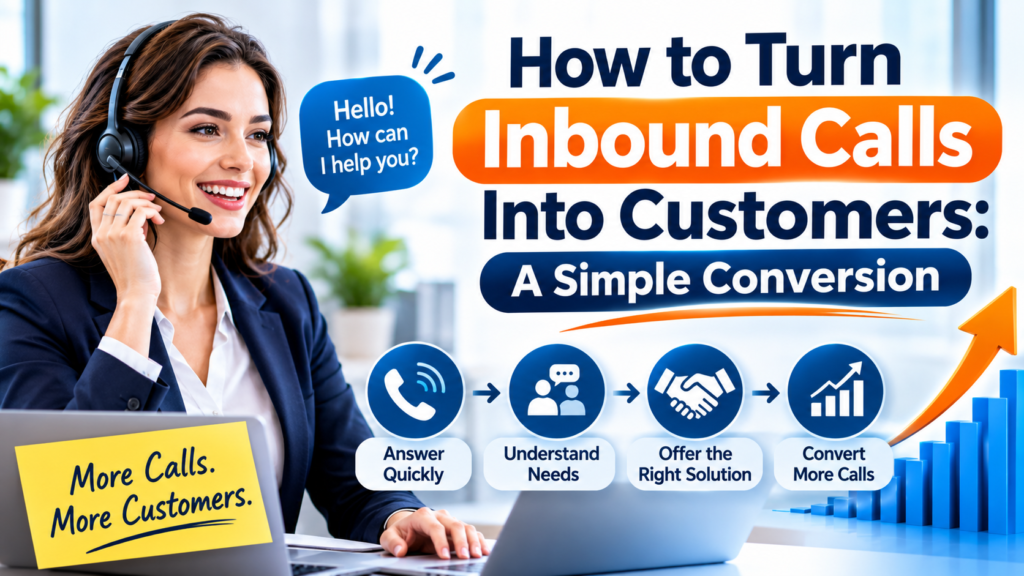
Discover how effective call handling and lead qualification can improve inbound call conversion.
When someone calls your business, they are actively seeking a solution. That action often signals stronger interest than passive website browsing, but it does not necessarily mean the caller is ready to buy. They may still be researching prices, comparing providers, or checking whether your services meet their needs. Your job at that moment is to understand what they need, establish whether your business is a good fit, and move the conversation toward a useful next step.
Inbound call conversion often suffers not because the product or service is wrong, but because someone handles the call poorly. Turning more callers into customers depends largely on what happens during and immediately after that first contact. A clear conversation, relevant answers, and timely follow-up can make the difference between a lost opportunity and a new customer.
Why Caller Intent Changes Everything
Understanding caller intent before you answer shapes how the conversation should go. A caller who just submitted a form and then dialed may be in a different headspace than someone who found your number through a search ad and called directly. The second caller may be further along in the decision-making process because they chose to speak with someone directly rather than submit a form. However, the caller’s actual readiness depends on their needs, research, budget, and reason for calling.
This distinction matters for sales call optimization because it changes your opening. If you treat an interested caller like someone who needs to be warmed up from the beginning, you risk wasting the momentum that brought them to you. Ask one or two focused questions early to confirm what they need, then move the conversation toward a relevant solution. Avoid reciting a script designed for cold outreach. Unnecessary questions and lengthy introductions can create friction and reduce the caller’s willingness to continue.
Inbound sales calls also carry a time-sensitive opportunity. Consumer interest can change as callers compare providers and explore alternatives. A caller who reaches voicemail or gets transferred multiple times may decide to contact another business. Speed and attentiveness are not just courtesies. They are important parts of an effective inbound call conversion process.
The Mechanics of a Call That Converts
Good call handling strategies share a few structural qualities regardless of industry. The opening should identify the caller’s need quickly. The middle should address that need with enough specificity to establish credibility. The close should provide a clear, low-friction next step. That sounds simple, and it is. What makes this challenging is maintaining consistency across all representatives and all call volumes.
A few things that reliably break the pattern:
- Putting the caller on hold too early. If you need information to continue, explain briefly why you need it and keep the pause as short as possible. A caller left waiting without an update may become frustrated or disengaged.
- Asking questions you should already know. If call tracking and analytics are in place, you may already know which ad the caller responded to, which page they visited, or which service they were exploring. Use that available context when appropriate. It helps create a more relevant conversation and signals competence.
- Failing to qualify before pitching. Lead qualification on a call is not a bureaucratic step. It protects both sides. A caller who receives a pitch for something they cannot use is unlikely to convert and may remember the experience negatively.
- No defined close. Every inbound call should end with either a confirmed next step or a clear reason why one is not appropriate yet. Saying “I’ll send you some information” without agreeing on a follow-up date or action can leave a valuable opportunity without direction.
What Call Tracking and Analytics Actually Tell You
Inbound call management without data is guesswork. Call tracking and analytics reveal which channels are producing calls, which campaigns are generating callers who become qualified opportunities, and where in the conversation things tend to fall apart. That last point is often underused.
Most teams look at call volume and call duration. However, neither metric independently demonstrates sales performance. A longer call may indicate a meaningful discussion, or it may reflect confusion, unresolved objections, or an inefficient conversation. Reviewing a sample of recorded calls regularly can provide more useful insight than relying on dashboard metrics alone. Search for patterns like, Where do callers ask the same question twice? Where do representatives struggle to explain an offer? At what point does the conversation shift from interested to noncommittal?
Tracking also supports sales funnel optimization by connecting the top of the funnel to actual outcomes. If a specific keyword or ad group drives high call volume but low inbound call conversion, the problem may be a mismatch between what the ad promised and what the caller experienced. That could indicate a targeting or messaging issue rather than a sales issue. Identifying the correct source of the problem helps businesses avoid wasting time and resources on the wrong solution.
To measure actual business impact, connect call tracking data with CRM records and sales outcomes. Track not only how many calls each campaign generates, but also how many become qualified opportunities, booked appointments, and paying customers. Platforms such as Google Ads support inbound call conversion tracking and the import of qualifying offline call outcomes, helping businesses connect advertising activity with meaningful results.
If your business records inbound calls for training or quality assurance, follow applicable call-recording, consent, and data-protection requirements. These rules can vary depending on the states and locations involved.
Lead Nurturing After the First Call
Not every inbound call closes on the first contact. That is not necessarily a failure. It is a normal part of customer acquisition for anything involving a meaningful decision, whether that is insurance coverage, a home improvement project, or a financial product. What matters is whether there is a clear lead nurturing process for callers who do not convert immediately.
Follow up promptly after the first conversation, with timing based on the caller’s urgency, preferences, and decision timeline. When possible, make the first follow-up within the same business day and reference the specific needs discussed during the call. A personalized message is more useful than a generic email. Callers who feel like a number may respond like one. A follow-up that says, “You mentioned you were comparing options before your renewal date,” is more likely to re-engage than a generic “Thank you for your interest in our services.”
Customer engagement across multiple touches can also help maintain contact with callers who are genuinely interested but not ready to make a decision. A mix of a phone call, a brief email, and possibly a text message (where compliant and appropriate) gives the caller multiple low-friction ways to re-engage without feeling pressured.
Building a Pipeline That Sends You the Right Callers
All the call handling in the world cannot fully compensate for a pipeline built on poorly targeted traffic. Inbound call conversion rate is partly a skills issue and partly a sourcing issue. If a meaningful share of your inbound calls comes from people who are not genuinely interested in your services, your conversion potential may be limited before anyone picks up the phone.
Consumer-initiated calls, where the caller actively chooses to contact a business based on their research or needs, can provide a useful indication of active interest. However, inbound call conversion performance still depends on the caller’s requirements, lead source, targeting, qualification standards, and how the business handles the conversation. Calls generated through cold transfers or incentivized click-to-call programs may have different levels of intent, but businesses should evaluate these sources using actual conversion data rather than assuming one category always performs better.
This is where the sourcing question becomes a strategic one. Agents and sales teams that invest in inbound call lead generation from relevant, verified sources may spend less time sorting through unsuitable inquiries and more time addressing opportunities that match their services. However, verification alone does not guarantee purchase readiness. Businesses should understand how a lead provider verifies callers, filters duplicate or invalid leads, defines intent, and measures lead quality.
The call handling strategies that work best rely on a consistent supply of relevant inquiries. When the right callers reach your team, representatives can focus more effectively on understanding their needs, presenting suitable solutions, and moving conversations toward a sale.
Putting It Together: A Practical Sequence
The path from inbound call to customer is not complicated, but it requires each step to be intentional.
- Answer as promptly as possible and identify the caller’s main need early. Keep the opening concise, professional, and focused on what the caller wants to accomplish.
- Use any available context from call tracking and analytics to personalize the opening and understand what prompted the inquiry.
- Qualify clearly but conversationally. Two or three focused questions can help confirm fit before moving to a solution.
- Address the specific need, not a general pitch. Callers who feel heard are more likely to remain engaged in the conversation.
- Close with a concrete next step that includes an agreed date, timeframe, or action.
- Follow up promptly with any caller who did not convert, referencing the actual conversation and respecting their preferred contact method.
- Review call recordings regularly to identify recurring friction points and improve the process across the team, rather than focusing only on individual representatives.
Teams that follow this sequence consistently can improve their inbound call conversion rate by reducing missed opportunities and creating a more reliable customer experience. The improvement does not come from one breakthrough technique. It comes from making each stage of the conversation more effective and more consistent.
If the bottleneck is not the conversation but the quality of callers reaching your team, the more effective fix may be upstream. Working with a source that specializes in Inbound Call Lead Generation and uses consumer-initiated traffic and defined verification processes can help your team receive more relevant inquiries. Evaluate how the provider sources and verifies calls, filters unsuitable leads, and measures quality before choosing a partner. When the callers reaching your team are a better match for your services, every call-handling strategy has a stronger opportunity to deliver results.