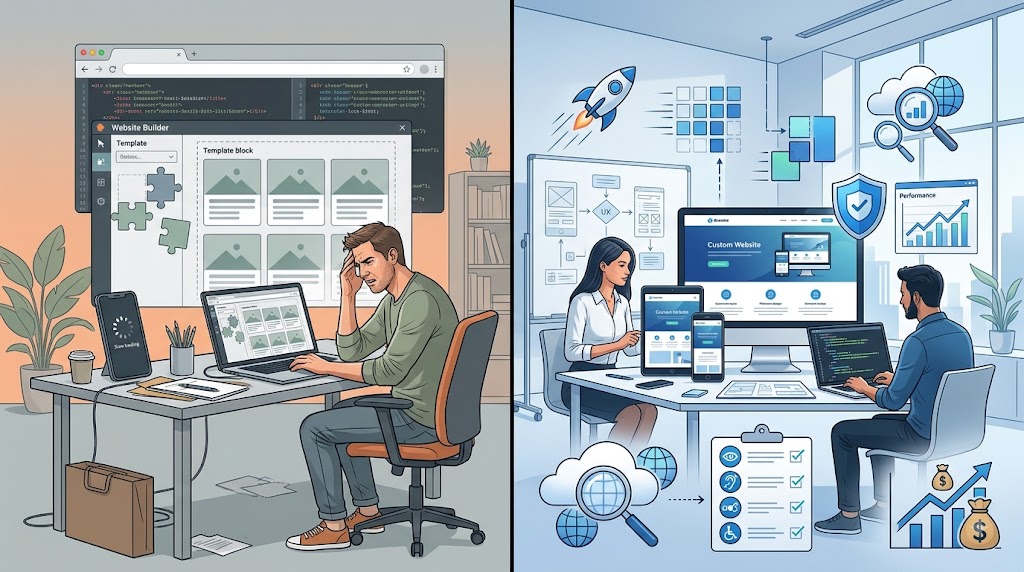
Machine intelligence has rewritten the rules of web creation. Platforms like Wix ADI, Framer AI, and Hostinger now position instant websites as the default option. You supply business details, choose visual preferences, and algorithms generate a polished layout. The convenience is remarkable.
For entrepreneurs operating at full capacity, this pitch feels like relief. Small business owners manage payroll, inventory, customer service, and marketing simultaneously. Skipping lengthy development timelines and preserving capital seems like obvious wisdom.
The equation changes when you evaluate what your site must accomplish. A rudimentary digital presence might tolerate automation. But when your website serves as a credibility engine, lead generator, and revenue catalyst—AI tools reveal their fragile foundations. Human expertise continues to prove its supremacy.
The Seduction of Simplicity
AI warrants acknowledgment for legitimate strengths. It delivers results at extraordinary speed. It requires minimal financial investment. It eliminates technical barriers for novices.
If you are documenting personal interests or testing market viability, AI builders fulfill a genuine need. You obtain a functional, visually acceptable site without coding expertise. The templates accommodate various devices. The designs appear contemporary.
But establishing an online presence and leveraging it competitively represent different challenges entirely. Once differentiation becomes essential, the shortcomings multiply.
The Uniformity Trap
AI operates through statistical synthesis. It ingests millions of websites and reproduces prevalent patterns. Request a site for a consulting firm, and you receive a consulting template.
Every competing consultant in your market receives that same template.
Visitors should absorb your distinct identity within seconds. They should comprehend what elevates you above alternatives. AI cannot manufacture this uniqueness. It produces interchangeable copy and inserts generic stock visuals by default.
A website designer begins with immersion. They investigate your brand story, your communication voice, and your strategic objectives. From this foundation, they construct a digital experience that embodies your character. The result carries unmistakable originality. It never resembles a recycled version of your industry peers.
The Emotional Intelligence Deficit
Exceptional design influences behavior through subtle guidance. It shapes decisions without demanding conscious attention.
AI can arrange elements according to established norms. It recognizes conventional placement for navigation and engagement points. But it cannot interpret emotional nuance.
A skilled practitioner traces the complete visitor arc. They probe: What anxiety prompted this visit? What evidence dissolves doubt? How do we transform hesitation into decisive action?
This demands authentic human empathy. AI is fundamentally unequipped for this. It depends on aggregate patterns and broad heuristics. But heuristics fail when confronted with specific business realities.
A pharmaceutical company and a handmade pottery studio require radically different psychological frameworks. A human designer identifies this distinction immediately. They architect experiences precisely tuned to your audience’s mindset.
Strategy: The Invisible Architecture
Your website functions as a business instrument, not ornamental digital space.
When you engage a web design company, you invest in strategic partnership. A capable team challenges superficial thinking. They expose dimensions you may have overlooked.
What precise challenge does your ideal customer confront daily? What makes your solution irreplaceable? What conversion action should dominate every visitor session?
AI builders bypass these explorations completely. They categorize your industry and apply a formula. Every chiropractic practice receives identical structure. Every e-commerce vendor gets the same framework.
This strategic void undermines effectiveness. A site without purpose is merely content occupying digital space. It will not transform curiosity into revenue.
The Flexibility Barrier
AI platforms function within closed ecosystems. They present a catalog of pre-approved capabilities. Operate within those parameters, and the experience is seamless.
The friction emerges when you require something unconventional. What if your operations demand a proprietary client interface? What if you need real-time synchronization with specialized external systems?
You encounter the platform’s rigid boundaries.
AI builders severely limit adaptability. Premium tiers may permit restricted code access, but constraints remain oppressive. The tool determines what is possible, not your operational necessities.
A human developer constructs precisely to your specifications. They do not impose compromises. Complex integrations, bespoke tools, and future scalability are all within reach. Your website evolves in parallel with your business.
Performance, Speed, and Search Visibility
Most owners never inspect their site’s underlying architecture. Search engines evaluate it relentlessly. Google weighs technical quality heavily in ranking algorithms.
AI builders frequently generate bloated, inefficient codebases. They inject superfluous scripts to power visual editing interfaces. Performance degrades measurably.
Page speed directly impacts search rankings. Sluggish sites descend in results. They also repel visitors. Research consistently demonstrates that user patience expires within mere seconds of delay.
A custom build is optimized by intention. Every component earns its place. Professionals compress assets, streamline scripts, and structure markup for maximum search engine efficiency.
Technical SEO extends considerably deeper. Experts implement structured data, manage pagination, and optimize crawl budgets. They understand authority distribution patterns. AI tools manage only surface-level SEO. They provide fields for basic meta tags but miss search intent entirely. A professional analyzes your competitive terrain. They architect information pathways that channel authority to your priority content. AI builders collapse under structural complexity because their foundations lack adaptability.
Accessibility and Brand Integrity
Digital accessibility carries legal obligations in numerous jurisdictions. Ethically, it represents fundamental inclusivity.
AI has advanced in this domain, yet deficiencies persist. Auto-generated image descriptions frequently mischaracterize visual content. Subtle color contrast violations escape automated detection. Keyboard navigation compatibility receives no meaningful verification.
A human team validates every checkpoint exhaustively. They simulate assistive technology experiences. They ensure comprehensive WCAG compliance. This diligence protects your business and honors all potential users.
Trust depends substantially on perceived investment. Visitors identify template-driven sites within moments. The impression suggests minimal effort and cost-conscious priorities.
A custom build radiates dedication. It communicates that your brand merits serious consideration. When prospects encounter thoughtful, original design, their confidence in your business strengthens measurably.
AI’s Rightful Place
AI occupies a valid niche in the ecosystem. A personal blog benefits from its accessibility. A temporary promotional page functions adequately. When financial resources are genuinely absent, AI surpasses complete digital invisibility.
For businesses with established momentum, however, AI becomes a constraining factor. It limits growth potential. It dissolves market differentiation. It removes the strategic foundation required to excel.
The most judicious use of AI is as a supplementary resource. A talented Singapore website designer might employ it for color exploration or rapid wireframing. But the creative vision and strategic decisions remain firmly human.
Final Assessment
A website represents a substantial business commitment. The minimal cost and immediate availability of AI builders are seductive. Scrutinize carefully, and the inherent compromises become transparent.
AI produces a website. A human produces a competitive business asset.
To cultivate trust, attract qualified visitors, and transform browsers into loyal customers, automation alone proves inadequate. You need strategic depth, creative distinction, and technical precision that only seasoned professionals can deliver.
What ultimately separates your business from the crowd is the human element. AI can generate code, but it cannot generate meaning. That requires a person.