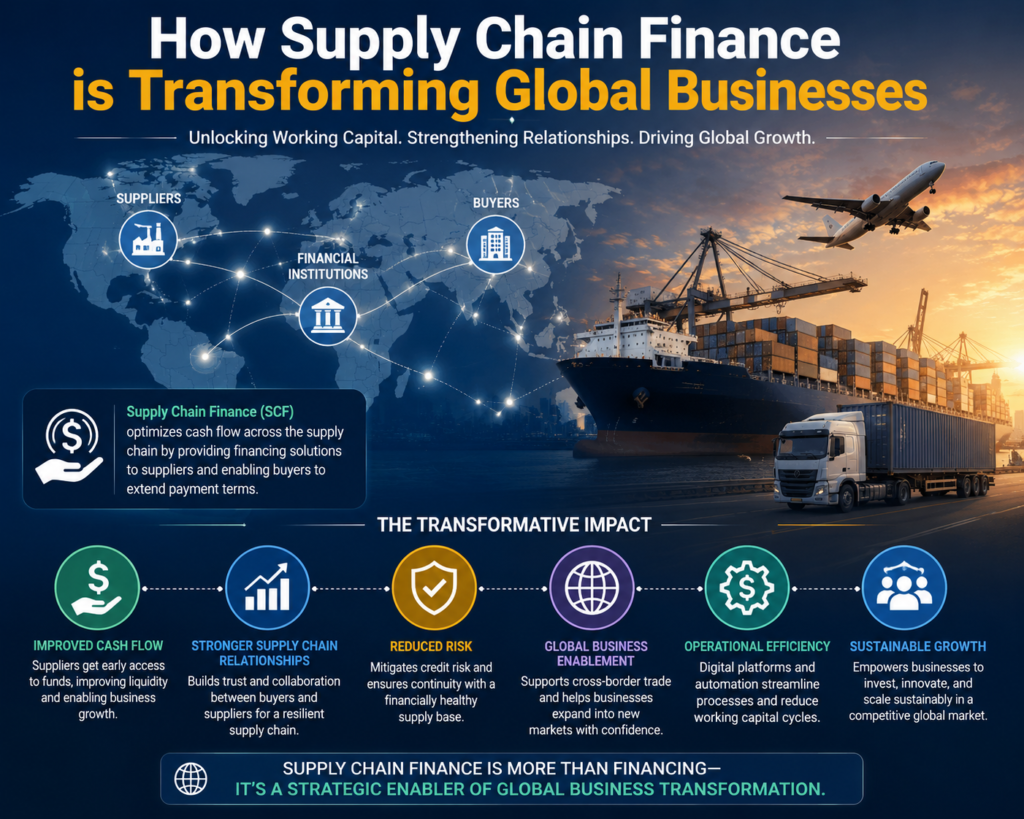
In today’s highly connected economy, businesses must manage complex supply chains while maintaining healthy cash flow and strong supplier relationships. Traditional financing systems often fail to meet the growing demands of modern commerce. This is where Supply Chain Finance (SCF) is making a significant impact.
Supply Chain Finance is transforming global businesses by improving liquidity, streamlining operations, and strengthening supply chain resilience. Companies across industries now rely on SCF solutions to improve working capital and maintain competitiveness in international markets.
As digital transformation accelerates worldwide, Supply Chain Finance is no longer just a financial tool. It has become a strategic business solution that helps organizations adapt to economic uncertainty and evolving customer demands.
What is Supply Chain Finance?
Supply Chain Finance is a set of financial solutions designed to optimize cash flow between buyers and suppliers. It enables suppliers to receive early payments on approved invoices while allowing buyers to extend payment terms.
The process usually works like this:
- A supplier delivers products or services to a buyer.
- The buyer approves the invoice.
- A financial institution pays the supplier early.
- The buyer pays the financier later according to agreed terms.
This system benefits both parties. Suppliers gain quicker access to funds, and buyers improve working capital management without harming supplier relationships.
Unlike traditional loans, Supply Chain Finance focuses on the strength of the buyer’s credit profile, which reduces financing costs for suppliers.
Why Supply Chain Finance is Becoming Essential
Global supply chains are becoming more complicated due to rising operational costs, inflation, geopolitical tensions, and economic disruptions. Businesses must ensure smooth cash flow while reducing financial risks.
Supply Chain Finance helps organizations solve these challenges by creating a more flexible and efficient payment ecosystem.
Companies that adopt SCF programs often experience:
- Better financial stability
- Improved supplier loyalty
- Enhanced operational efficiency
- Reduced payment delays
- Stronger global competitiveness
Today, businesses of all sizes are investing in Supply Chain Finance to create more agile and resilient supply chains.
Major Ways Supply Chain Finance is Transforming Global Businesses
1. Improving Working Capital Efficiency
One of the biggest advantages of Supply Chain Finance is its ability to improve working capital efficiency.
Many suppliers struggle with delayed payments that affect daily operations. Waiting several months for invoice payments can create serious cash flow problems, especially for small and medium-sized businesses.
Supply Chain Finance allows suppliers to receive payments much faster. This gives them immediate access to cash that can be used for:
- Purchasing inventory
- Expanding operations
- Paying salaries
- Managing production costs
- Investing in innovation
Meanwhile, buyers can maintain longer payment terms without damaging supplier trust.
This balance creates healthier financial relationships throughout the supply chain.
2. Strengthening Supplier Relationships
Strong supplier relationships are critical for long-term business success.
When suppliers face financial pressure because of late payments, the entire supply chain becomes vulnerable. Production delays, inventory shortages, and operational disruptions can occur.
Supply Chain Finance helps businesses build stronger partnerships with suppliers by ensuring predictable and timely payments.
Suppliers who benefit from SCF programs often become more reliable and committed business partners. This can lead to:
- Better pricing agreements
- Improved product quality
- Priority service during shortages
- Long-term collaboration opportunities
Global organizations increasingly use Supply Chain Finance as a strategic tool to strengthen supplier networks.
3. Reducing Financial Pressure on Suppliers
Traditional financing methods are often expensive for smaller suppliers because banks consider them high-risk borrowers.
With Supply Chain Finance, financing costs are usually lower because the buyer’s stronger credit rating supports the transaction.
This reduces financial pressure on suppliers and helps them avoid high-interest loans or credit lines.
As a result, suppliers can focus more on operational growth rather than short-term financial survival.
This financial stability creates a healthier and more sustainable supply chain ecosystem.
4. Increasing Supply Chain Resilience
Global supply chains face frequent disruptions caused by economic crises, political instability, pandemics, and natural disasters.
Financially weak suppliers are more likely to collapse during uncertain times, creating major operational risks for buyers.
Supply Chain Finance improves resilience by ensuring suppliers maintain steady access to working capital.
A financially secure supplier network can continue operations even during difficult market conditions.
Businesses that invest in SCF programs are often better prepared to handle unexpected disruptions and maintain continuity.
5. Supporting Global Expansion
International trade requires businesses to manage multiple suppliers, currencies, and payment systems across different regions.
Supply Chain Finance simplifies cross-border transactions and improves global financial coordination.
Companies expanding into international markets can use SCF to:
- Improve supplier confidence
- Reduce payment delays
- Manage foreign currency risks
- Enhance international trade efficiency
This makes Supply Chain Finance an important growth strategy for multinational organizations.
The Role of Technology in Supply Chain Finance
Technology plays a major role in the rapid growth of Supply Chain Finance solutions.
Modern SCF platforms use advanced technologies to automate processes, improve transparency, and reduce operational costs.
Artificial Intelligence (AI)
AI helps businesses analyze supplier data, predict financial risks, and identify opportunities for process improvement.
Blockchain Technology
Blockchain creates secure and transparent transaction records that reduce fraud and improve trust among stakeholders.
Cloud-Based Platforms
Cloud technology allows businesses to manage financing operations from anywhere while improving scalability and collaboration.
Automation
Automated invoice approvals and payment processing reduce manual work and speed up transactions.
Data Analytics
Real-time analytics help companies monitor supplier performance, track cash flow, and make informed financial decisions.
Technology-driven Supply Chain Finance solutions are making financial operations faster, safer, and more efficient than ever before.
Industries Benefiting from Supply Chain Finance
Many industries are experiencing major benefits from Supply Chain Finance.
Manufacturing Industry
Manufacturers use SCF to maintain smooth production cycles and support large supplier networks.
Retail Industry
Retail companies rely on Supply Chain Finance to manage seasonal inventory demands and improve supplier coordination.
Healthcare Sector
Healthcare providers use SCF to ensure continuous access to medical supplies and pharmaceutical products.
Automotive Industry
Automotive companies benefit from improved supplier stability and production efficiency.
Technology Sector
Technology businesses use Supply Chain Finance to manage complex international supplier ecosystems.
As industries continue digitizing operations, SCF adoption is expected to increase further.
Challenges of Implementing Supply Chain Finance
Although Supply Chain Finance offers many advantages, businesses may face some implementation challenges.
Technology Integration
Integrating SCF systems with existing software platforms may require investment and technical expertise.
Supplier Participation
Some suppliers may hesitate to adopt new financial technologies due to lack of awareness or training.
Regulatory Compliance
Global businesses must comply with different financial regulations across countries.
Data Security Risks
Protecting sensitive financial data is essential when using digital financing platforms.
Despite these challenges, businesses that successfully implement Supply Chain Finance often gain substantial long-term benefits.
Future Trends in Supply Chain Finance
The future of Supply Chain Finance looks extremely promising as digital innovation continues to reshape global commerce.
AI-Powered Decision Making
Artificial Intelligence will further improve risk management and financial forecasting.
Blockchain Expansion
Blockchain adoption will increase transaction transparency and security.
Sustainable Finance Models
Businesses are increasingly connecting Supply Chain Finance programs to sustainability and ESG goals.
Increased SME Participation
More small and medium-sized enterprises will gain access to affordable financing solutions.
Embedded Financial Services
Financial services will become more integrated into supply chain management platforms.
Experts and industry platforms like BCR Pub continue to discuss how Supply Chain Finance is shaping the future of global business operations.
Why Businesses Should Invest in Supply Chain Finance
Businesses that adopt Supply Chain Finance gain several competitive advantages.
These include:
- Improved cash flow
- Lower financing costs
- Better supplier relationships
- Stronger operational efficiency
- Enhanced supply chain stability
- Greater resilience during economic uncertainty
In today’s competitive business environment, companies cannot afford inefficient financial processes. Supply Chain Finance provides a modern solution that supports sustainable growth and operational excellence.
Organizations using Supply Chain Finance are better positioned to succeed in rapidly changing global markets.
Conclusion
Supply Chain Finance is revolutionizing global business operations by improving liquidity, strengthening supplier relationships, and increasing supply chain resilience.
As companies continue facing economic uncertainty and growing operational complexity, SCF has become an essential financial strategy for long-term success.
By combining advanced technologies with innovative financing models, Supply Chain Finance helps businesses build more efficient, flexible, and sustainable supply chains.
The future of global commerce will increasingly depend on smart financial ecosystems, and Supply Chain Finance will remain at the center of this transformation.
FAQs
1. What is Supply Chain Finance?
Supply Chain Finance is a financing solution that allows suppliers to receive early payments while buyers extend payment terms to improve cash flow management.
2. How does Supply Chain Finance help businesses?
It improves liquidity, reduces financing costs, strengthens supplier relationships, and enhances supply chain stability.
3. Is Supply Chain Finance suitable for small businesses?
Yes. Small and medium-sized businesses can benefit greatly from faster access to working capital and lower financing costs.
4. What technologies are used in Supply Chain Finance?
Modern SCF platforms use technologies like Artificial Intelligence, blockchain, automation, cloud computing, and data analytics.
5. Why is Supply Chain Finance important for global trade?
Supply Chain Finance supports international business operations by improving payment efficiency, reducing financial risks, and strengthening supplier networks worldwide.