Publishing a website takes considerable effort. You invest time, capital, and creative energy into the project. You collaborate with a professional to shape the final product. The site goes live, and you check another item off your list. At this moment, the urge to forget about it completely is quite strong.
But websites cannot survive on their own. They require persistent care to remain useful. Think of them like a musical instrument. A piano can sound beautiful when new, but without regular tuning, cleaning, and string adjustments, it will eventually produce discordant notes. Websites operate on the same principle.
Consistent upkeep keeps your site safe, fast, and dependable. Ignoring it results in security weaknesses, malfunctioning elements, and frustrated users. Let us look at why this ongoing commitment matters and what happens when you disregard it.
The Illusion of a Finished Project
A common misunderstanding surrounds the nature of websites. Many owners treat them as final products. They equate them with printed flyers or billboards. Once those items are produced, the work is complete. This line of thinking does not hold up under scrutiny.
Your website operates as software on a web server. It uses a content management system to publish and organize content. It employs themes to control its appearance. It uses plugins to add extra capabilities. Developers release frequent updates for all these pieces. These updates address bugs, close security gaps, and improve speed. If you do not install them, your site becomes outdated.
A neglected site develops multiple problems. It runs slowly on newer devices. It becomes a target for malicious actors. It may break when browsers change. Launching the site is merely the first action in a long process.
The Unchanging Reality of Online Risks
Automated threats are ever-present on the internet. They scan for vulnerable websites every second. They do not care about your business type or size. Any weakness presents an opportunity for exploitation.
Attackers use outdated software to enter your systems. Once inside, they can take customer data. They could alter your web pages or redirect your visitors. They might use your server capacity for harmful activities. Cleaning up after such an incident is costly and damaging. Your reputation suffers, and search engines may flag your site.
Maintenance involves installing patches quickly. It also requires monitoring for signs of intrusion. This approach is similar to locking your car doors. It is a simple habit that prevents most theft.
The Link Between Quality and Perception
Picture yourself at a hotel with torn sheets and broken lamps. You would feel uncomfortable and likely leave. Your impression of that establishment would be negative.
A neglected website creates this same feeling. Users encounter pages that do not load. They find links that lead nowhere. Forms fail to submit correctly. Visitors get annoyed and go elsewhere.
Every technical failure says something about your business. If your website cannot function properly, customers may doubt your competence. Regular maintenance finds these problems early. It ensures users have a smooth experience that builds confidence.
Search Engine Factors
Search platforms want to show users the best available results. Their algorithms reward websites with strong technical performance. They penalize those with slow loading, broken features, or security warnings.
When upkeep slips, speed decreases. Accumulated code and database bloat lengthen page load times. Broken links obstruct search crawlers. Search engines detect these conditions and lower your positions.
A security compromise triggers immediate search warnings. Google displays a notice that your site may be dangerous. This notice drives most users away. Routine maintenance safeguards your search rankings and maintains visitor flow.
The Hidden Price of Avoidance
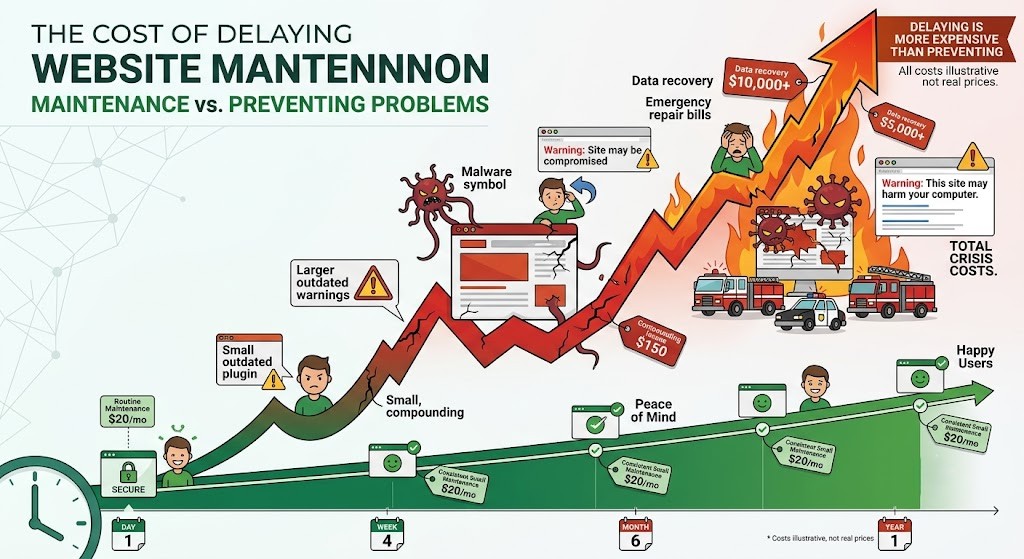
Some site owners choose to skip maintenance to cut expenses. It seems like an extra cost when everything appears fine. This decision often leads to bigger bills later.
Restoring a badly damaged site requires much more than ongoing care. Emergency assistance from technicians is expensive. If your backups are missing, you must rebuild all lost content.
Think of maintenance as a small payment that prevents bigger ones. Regular service avoids catastrophic failures. This financial approach is generally more sound.
What Maintenance Includes
Website care encompasses several different tasks done on a schedule. It is not just checking if your site is visible. Here are the essential pieces.
Software Management: Apply updates to your content management system, themes, and extensions. These updates can sometimes cause issues. A proficient website designer tests them in a staging area before moving to your live website.
Backup Solutions: Maintain automated backups in a separate location. If trouble strikes, you can restore your site quickly.
Security Oversight: Run frequent scans for malware and suspicious logins. Update firewall rules to handle new threats.
Speed Monitoring: Check loading times regularly. Optimize images, clear database clutter, and remove unnecessary code.
Link Reviews: Examine all links throughout your site. Fix broken ones and set up redirects appropriately.
Content Adjustments: Update copyright details, personnel information, and operating hours. Test forms to ensure they deliver messages correctly.
Professional Assistance
You might be able to handle some maintenance tasks yourself. Running backups and updating plugins are possible for many. But consistent execution requires time and some technical know-how.
Professional support offers valuable advantages. An experienced website designer follows safe procedures. They know which updates need priority and which can wait. They can spot performance drops before visitors do.
Outsourcing this responsibility lets you focus on your core activities. You gain reassurance about your site’s security and operation. You avoid learning specialized technical skills.
Developing Sustainable Routines
Website maintenance is not exciting or immediately rewarding. It is easy to postpone for more visible work. Yet it forms the essential support for your online presence.
Without it, you risk data loss, reduced visibility, and damaged trust. With it, your site remains a reliable business resource.
Do not wait for an emergency. Establish a regular maintenance schedule now. Whether you manage it yourself or work with a professional, make ongoing care a consistent priority.