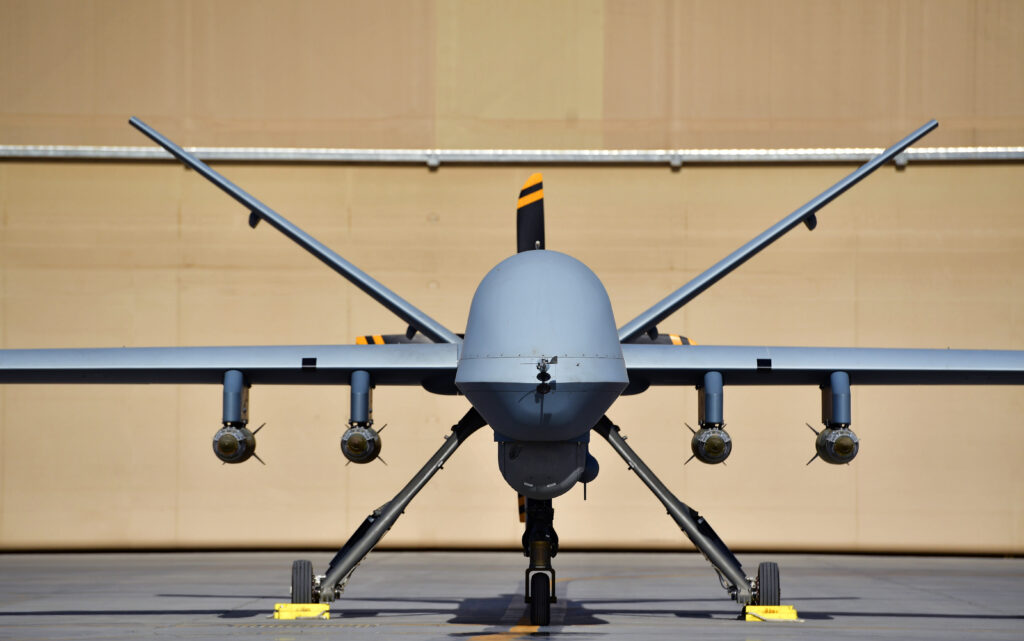
A U.S. Air Force MQ-9 Reaper, assigned to the 62nd Expeditionary Reconnaissance Squadron, armed with four GBU-38 Joint Direct Attack Munition, parks on a flightline before a mission on Kandahar Airfield, Afghanistan Feb. 22, 2018. The 62nd ERS provides close air support, intelligence, surveillance and reconnaissance capabilities in Afghanistan.(U.S. Air Force photo by Tech. Sgt. Paul Labbe)
Introduction
xCell is the mobile manufacturing cell that ends the era of waiting for drones to arrive from 8000 miles away. Firestorm Labs built it so that when a drone crashes, gets shot down or runs out of batteries, you don’t call for help – you just walk 50 meters to the container and print a new one. In one or two standard shipping containers, xCell runs completely off-grid, needs only one or two people to operate, and produces up to 50 Group 2 drones per month. No runway. No port. No permission from a supply sergeant. This is the factory that follows the fight. This blog explains exactly how xCell works, why it changes everything and why every serious military unit and disaster-response team will demand one.
Why We Needed a Mobile Manufacturing Cell
Old drone factories are sitting ducks. They live in big buildings in safe cities. When the enemy hits ports, airfields and highways, those factories keep building while the troops on the ground run out of drones in three days. Firestorm asked a simple question: what if the factory itself could drive, sail or fly to the troops? What if it could hide in the trees, run on a generator and keep printing new airframes while the battle rages? xCell is the answer. It turns every forward operating base into its own drone factory. No more “sorry, the replacement is stuck in transit.” You print it yourself – today.
How xCell Actually Works
xCell arrives in one or two 20-foot or 40-foot containers that look exactly like every other container on the ship or truck. Operators open the doors, extend the sides, start the generator and begin printing. Inside are multiple HP Multi Jet Fusion 3D printers, robotic arms for assembly, finishing stations and quality-check cameras. The software is so simple that one person can run it. The second person loads powder and checks finished parts. Raw polymer powder is stored onboard – enough for 30 to 60 days of hard use. A full Tempest drone comes out ready to fly in 9 to 24 hours. A spare wing or motor mount takes only a few hours. Connect the OCTRA brain, load the mission software from Warroom and you are airborne again.
Real Missions – Real Results
In classified exercises with Marine Littoral Regiments, one xCell kept eight drones flying for 21 days while the entire supply chain was “destroyed” in the scenario. In another test a damaged drone got a new wing printed and bolted on in under six hours – no helicopter, no resupply convoy. The same container has already printed medical-delivery quadcopters in disaster simulations, proving that the mobile manufacturing cell works equally well for combat and humanitarian missions.
Hard Problems, Solved
Heat, dust and rain? Rugged enclosures and automatic calibration keep printers running. Cyber attack? Air-gapped network and physical kill switches. Only one or two operators? Warroom digital twin trains them in 100 perfect flight hours before they ever touch real parts. The container itself can be camouflaged or buried so the enemy never finds it. That is why xCell is not a prototype – it is already deployed.
The Next 36 Months
Firestorm’s plan is public and aggressive: 2026 – network ten xCells to print 500 drones per month. 2027 – AI designs a brand-new airframe from mission requirements in under 24 hours. 2028 – hybrid metal-polymer printing for heavy Group 4 drones. At the same time civilian versions are already being tested for wildfire mapping, flood rescue and remote medical delivery. One factory, endless missions.
Conclusion
xCell is not a gadget. It is the end of the supply-chain nightmare and the beginning of true battlefield autonomy. Firestorm Labs has taken the factory out of the safe rear area and put it exactly where the troops need it – right beside them. The next war will not be won by the side that starts with the most drones. It will be won by the side that never runs out of drones. xCell guarantees that side will be us. Every commander who has seen it in action says the same thing: “We need ten of these yesterday.”
FAQs
- What exactly is xCell?
A mobile manufacturing cell inside shipping containers that 3D-prints complete drones and spare parts off-grid at the forward edge. - How many drones can one xCell make in a month?
Up to 50 Group 2 airframes or hundreds of smaller Group 1 drones – every month, continuously. - How many people does it take to run xCell?
Only one or two operators. The rest is automated. - Does it need a big power plant or internet?
No. Runs on its own generator. No internet required – everything stays air-gapped. - Can xCell print drones for other companies or allies?
Yes – open architecture means it prints any compatible design, not just Firestorm models.