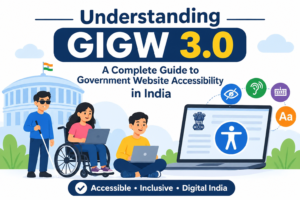
Understanding GIGW 3.0 Accessibility
In today’s digital world, government websites play an important role in providing citizens with information, public services, and online facilities. However, these services should be accessible to everyone, including people with disabilities, senior citizens, and individuals using different devices and assistive technologies.
To improve the quality and accessibility of government websites, the Government of India introduced GIGW 3.0 (Guidelines for Indian Government Websites). These guidelines provide a framework for developing secure, user-friendly, accessible, and reliable government websites and applications.
GIGW 3.0 focuses on creating a better digital experience while ensuring that government information and services are available to all citizens.
What Is GIGW 3.0?
GIGW 3.0 stands for Guidelines for Indian Government Websites, Version 3.0. It was developed through collaboration involving the National Informatics Centre (NIC), the Standardisation Testing and Quality Certification Directorate (STQC), and the Indian Computer Emergency Response Team (CERT-In).
Released in February 2023, this updated version builds on earlier government website guidelines and introduces stronger recommendations for accessibility, security, quality, and website lifecycle management.
The main objective is to help government departments create websites and mobile applications that are citizen-centric, secure, consistent, and easy to use.
Key Objectives of GIGW 3.0
GIGW 3.0 aims to improve the overall quality of digital government services. Its important objectives include:
- Digital Accessibility: Making websites and applications usable by people with different abilities.
- Website Security: Improving protection against cyber threats and unauthorized access.
- Better User Experience: Creating simple navigation and user-friendly website layouts.
- Content Quality: Providing accurate, updated, and easy-to-understand information.
- Mobile Usability: Improving accessibility and usability across smartphones and other devices.
- Website Management: Encouraging proper monitoring, maintenance, and lifecycle management.
These objectives help government organizations deliver more reliable and inclusive digital services.
Why Is Accessibility Important Under GIGW 3.0?
Digital accessibility ensures that everyone can use online information and services, regardless of their physical or cognitive abilities.
People with visual impairments may depend on screen readers, while individuals with hearing disabilities may require captions or transcripts. People with mobility disabilities may need keyboard navigation instead of a mouse.
An accessible government website should consider these different requirements.
Some important accessibility practices include:
1. Screen Reader Compatibility
Websites should provide meaningful headings, labels, descriptions, and alternative text for images. These features help screen readers communicate website content to people with visual disabilities.
2. Keyboard Navigation
Users should be able to access menus, links, forms, and other interactive elements using a keyboard. Clear focus indicators make navigation easier.
3. Colour Contrast and Readable Text
Text should have sufficient contrast against its background. Websites should also use readable fonts, appropriate spacing, and clear content structures.
4. Captions and Multimedia Accessibility
Videos should include captions, while audio content should provide transcripts wherever appropriate. This helps people with hearing disabilities access multimedia information.
5. Mobile-Friendly Design
Government websites should work effectively on different screen sizes. Responsive layouts help users access services through smartphones, tablets, and desktop computers.
Understanding the Connection Between GIGW 3.0 and WCAG
The Web Content Accessibility Guidelines (WCAG), developed by the World Wide Web Consortium (W3C), provide internationally recognized recommendations for making digital content accessible.
WCAG is based on four important principles:
- Perceivable: Users must be able to perceive website information.
- Operable: Website functions should be accessible through different input methods.
- Understandable: Content and navigation should be easy to understand.
- Robust: Websites should work with different browsers and assistive technologies.
Following these principles helps organizations improve their digital accessibility practices and support the broader goals of GIGW 3.0.
Benefits of GIGW 3.0 Compliance for Government Websites
Implementing GIGW 3.0 can provide several benefits to government organizations and citizens.
Improved Citizen Experience: Simple navigation and accessible content make government information easier to find.
Greater Digital Inclusion: People with disabilities can access online services with fewer barriers.
Enhanced Website Security: Better security practices help protect government platforms and user information.
Increased Trust: Accurate information, reliable services, and consistent website experiences help build public confidence.
Better Website Quality: Regular monitoring and maintenance encourage long-term website performance and usability.
How Organizations Can Improve GIGW 3.0 Compliance
Government departments and website development teams should consider accessibility and quality throughout the website development process.
Practical steps include conducting accessibility audits, testing websites with assistive technologies, improving website navigation, updating outdated content, and reviewing security practices.
Organizations should also involve accessibility experts and people with disabilities during testing. Their feedback can identify usability barriers that automated tools may overlook.
Working with experienced digital accessibility professionals, such as Accessible Minds, can also help organizations understand accessibility requirements and improve their digital platforms.
Conclusion
GIGW 3.0 is an important framework for improving government website quality, accessibility, security, and usability in India. It encourages government organizations to create digital platforms that serve citizens with different needs and abilities.
However, achieving meaningful digital inclusion requires continuous improvement, regular testing, and a commitment to accessible design.
By adopting GIGW 3.0 principles and following recognized accessibility practices, organizations can build more inclusive digital experiences where everyone has an equal opportunity to access government information and services.